When a structural weld fails on a job site, everything stops, schedules collapse, budgets bleed, and safety becomes a serious concern. That is exactly why choosing the right carbon steel welding services in Houston, TX is one of the most critical decisions any industrial or commercial project manager will make. At Alvator Custom Fab, we have built our reputation on precision, reliability, and the kind of craftsmanship that holds up under real-world stress not just on paper.
Carbon steel is the backbone of modern construction, manufacturing, and infrastructure. It is tough, cost-effective, and incredibly versatile. But working with it demands more than just a welding machine and a helmet. It requires deep knowledge of metallurgy, heat control, joint preparation, and post-weld inspection. Houston’s industrial landscape from petrochemical plants to commercial construction sites demands welders who understand all of this without being told twice.
What Makes Carbon Steel the Most Widely Used Metal in Industrial Fabrication
Carbon steel is at the heart of nearly all major industrial projects located in Houston. It is available in low, medium and high carbon coarseness and has different mechanical properties and welding requirements. Low-carbon steel is easier to weld and is more ductile and suitable for structural use. Medium and high-carbon steels are harder and require more careful control of the heat input and preheating to ensure that they are not cracked.
The American Welding Society (AWS) reports that the majority of structures welded in North America are made of carbon steel. That statistic alone is proof that it’s crucial to get things right the first time.
Why Carbon Grade Matters Before Striking an Arc
All carbon steel is not equal when heated. If a welder welds all carbon steel the same way, he will have problems of warping, porosity, cold cracking, or incomplete fusion. Houston’s professional carbon steel fabricators take carbon equivalent values into account before determining the process to be used. It’s a common requirement in AWS D1.1 welding codes and makes your welding company stand out from the rest.
How Material Thickness Influences the Welding Process
Thin carbon steel sections require lower heat input and faster travel speeds to avoid burn-through. Heavy-duty carbon steel plates and pipes used in industrial settings need deep penetration passes, often with pre-heat cycles ranging from 150°F to 400°F depending on the alloy. Getting this wrong does not just create weak welds, it creates liability.
The Core Welding Processes Used in Carbon Steel Fabrication
There is no single welding process that works perfectly for every carbon steel application. Professional welding and fabrication experts in Houston use different techniques based on joint type, position, material thickness, and project environment.
Stick Welding for Field and Heavy-Duty Repair Work
Stick welding, or Shielded Metal Arc Welding (SMAW), has been around for over a century and remains one of the most practical processes for on-site carbon steel repair. It works in wind, rain, and outdoor conditions where MIG shielding gas would be useless. For heavy equipment welding, Aluminum carbon steel welding structure repair, and industrial maintenance welding in the field, stick welding is reliable, adaptable, and powerful. Houston’s industrial facilities rely on stick-certified welders for shutdown maintenance and emergency repair situations where downtime is the enemy.
MIG Welding for Speed and Consistency in Commercial Applications
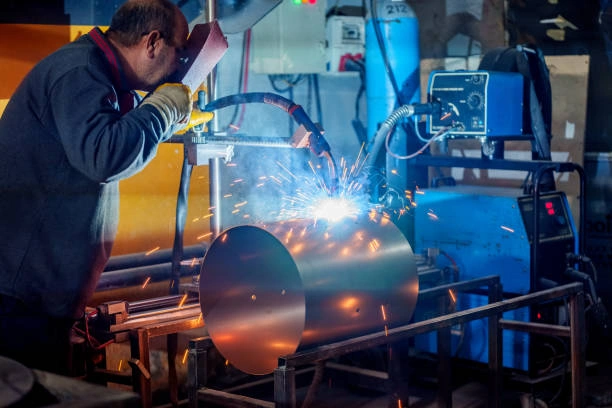
MIG welding or Gas Metal Arc Welding (GMAW) is the go-to process for high-volume commercial metal fabrication. It uses a continuously fed wire electrode and a shielding gas to produce clean, consistent welds at high deposition rates. For carbon steel fabrication in shop environments, MIG welding delivers excellent productivity without sacrificing quality. Certified welding specialists at Alvator Custom Fab use MIG welding extensively for structural steel components, frames, brackets, and assemblies that require repeatable, high-integrity joints.
TIG Welding for Precision and Critical Joints
TIG welding Gas Tungsten Arc Welding (GTAW) is the precision tool of the trade. It produces the cleanest welds with the tightest tolerances, which is why it is heavily used in pipe welding, pressure vessel fabrication, and root pass work on critical structural joints. TIG welding requires more skill and patience than MIG, but the results are significantly higher in quality. When a project cannot afford weld defects and most industrial applications in Houston cannot, TIG is the right call.
Structural and Pipe Welding: The High-Stakes Applications in Houston’s Industrial Sector
Houston’s economy runs on petrochemical processing, manufacturing, power generation, and commercial construction. Each of these industries demands structural carbon steel welding and carbon steel pipe welding that meets strict code compliance standards.
Structural Steel Welding That Meets AWS D1.1 Standards
Structural steel fabrication is one of the most code regulated jobs in the welding field. All welds for structural applications such as beams, columns, connections, braces shall meet AWS D1.1 or project specific engineering requirements. Employed certified Carbon Steel Welding Services in Houston, TX that follow these standards are required to perform regularly and pass performance qualification tests, and are required to use qualified welding procedure specifications (WPS). This is not an option! It’s the standard required of any serious structural welding contractor.
Every structural application begins by looking at the engineering drawings, choosing the correct filler metal and confirming the WPS before the first arc is struck at Alvator Custom Fab. That’s the way that professional fabrication services differ from cut-rate services.
Carbon Steel Pipe Welding in Petrochemical and Industrial Environments
It is a stand-alone craft called pipe welding. The ASME B31.3 or API 1104 standard isu typically required for carbon steel pipe welding in the industrial sector of Houston. These codes cover everything from joint design and fit up to welding parameters to nondestructive examination requirements. A leaky pipe weld in a chemical plant or refinery is a maintenance problem, a safety issue.
A professional pipe welding contractor from Houston is familiar with all of the requirements of these standards. They record, trace and third-party welding inspection without hesitation.
Mobile Carbon Steel Welding Services: Bringing the Shop to Your Job Site
Not all projects will fit into a fabrication shop and not all repairs can wait until a part can be pulled and shipped back. That’s where mobile welding services come in handy for Houston’s industrial and commercial customers.
Mobile carbon steel welding services enable qualified welders to move from one location to another, making on-site welding and repair possible; for on-site welding and repair, qualified welders are needed to move to the site. This eliminates expensive downtime, decreases equipment transportation dangers, and enables repairs to take place in real-time.
The mobile welding team at Alvator Custom Fab can be on-site to perform all types of welding services from emergency steel repair to maintenance welding on the planned projects at your facility. We do the heavy lifting, we do the job right, and we provide the tools, the skills, and the paperwork to get the job done – without any unnecessary downtime.
When a turnaround is scheduled, when several pieces of equipment are due for inspection, repair, and re-certification in a short period of time, an on-site carbon steel welding service is particularly useful. A welding contractor working within your maintenance team throughout a turnaround is not a luxury, it’s a strategy.
Custom Carbon Steel Fabrication: When Off-the-Shelf Solutions Are Not Enough
Standard steel components work for standard problems. But Houston’s industrial projects rarely deal in standard problems. Custom carbon steel welding solutions are what bridge the gap between what a manufacturer catalogs and what an engineer actually needs.
Custom steel fabrication involves designing, cutting, fitting, and welding carbon steel components to exact specifications brackets, frames, supports, skids, platforms, tanks, and assemblies that do not exist anywhere else. This work requires close coordination between fabricators, engineers, and project managers to ensure that every dimension, material grade, and weld detail matches the design intent.
Precision Fabrication for Industrial Equipment and Steel Structures
Precision welding services for industrial steel fabrication demand tight tolerances and consistent quality control throughout the process. That means checking fit-up before welding, monitoring interpass temperatures during welding, and performing visual and dimensional inspection after welding. At Alvator Custom Fab, we treat every custom fabrication project as a quality-controlled build, not just a job to check off.
Steel Structure Repair and Modification for Existing Facilities
Many Houston industrial facilities were built decades ago. The steel structures supporting their equipment, piping, and platforms eventually need repair, reinforcement, or modification. Industrial steel repair requires careful assessment of the existing weld quality, base metal condition, and load requirements before any new welding begins. Cutting into old structural steel without this analysis is how accidents happen.
Our team evaluates existing conditions, develops a repair plan that meets current code requirements, and executes the work with full documentation so facilities managers have a complete record for their compliance files.
Welding Inspection and Quality Assurance: The Final Line of Defense
A weld you cannot verify is a weld you cannot trust. Welding inspection is not a formality; it is the quality gate that confirms structural integrity before a load is applied or a system is pressurized.
Professional industrial welding companies in Houston offer or coordinate multiple levels of inspection depending on the application. Visual inspection is the baseline and is required on virtually every weld. Beyond that, nondestructive testing methods like ultrasonic testing (UT), magnetic particle inspection (MT), and radiographic testing (RT) are used on structural and pressure-containing welds to detect subsurface defects without destroying the component.
Certified welders who understand inspection requirements do not resist the process; they welcome it. It validates their work and gives clients confidence. At Alvator Custom Fab, we support third-party inspection and maintain all required documentation as a standard part of our service delivery.
Why Houston Businesses Trust Certified Welding Specialists for Long-Term Results
Houston is home to some of the most demanding industrial operations in North America. The Gulf Coast petrochemical complex, the Port of Houston, the energy sector, and a massive commercial construction market all create an environment where welding quality has direct economic and safety consequences.
Certified welders in Houston who hold AWS Certified Welding Inspector (CWI) credentials or hold active welder qualifications under AWS, ASME, or API codes are held to a higher standard and that standard shows in the work. Hiring uncertified labor to save money on a structural or pipe welding project is a short-term decision with long-term consequences.
The industrial welding company you choose should be able to demonstrate active certifications, a documented quality management process, a track record of completed projects in Houston’s industrial sector, and the capacity to scale with your project needs. Alvator Custom Fab checks every one of those boxes
Conclusion
Carbon steel welding is not a commodity service, it is a technical discipline that directly impacts the safety, performance, and longevity of your project. Whether you need structural steel fabrication, carbon steel pipe welding, Affordable Carbon Steel Welding Services in Houston, TX, metal fabrication, or emergency on-site repair, the quality of your welding contractor determines the quality of your outcome. Alvator Custom Fab brings certified expertise, proven processes, and a genuine commitment to getting it right to every project we take on in Houston, TX. If you are looking for a welding and fabrication partner who treats your project with the seriousness it deserves, the conversation starts here.
FAQ’s
Yes, many carbon steel grades, especially medium and high-carbon steels, require pre-heating to prevent hydrogen-induced cracking. The required pre-heat temperature depends on the carbon equivalent of the steel, the base metal thickness, and the heat input of the welding process. AWS D1.1 and project-specific WPS documents define these requirements.
Absolutely. Mobile carbon steel welding services make it possible to perform structural welding, pipe welding, and steel repairs directly at your facility. On-site services reduce downtime and eliminate the cost of disassembling and transporting large components to a shop.
Signs include visible cracks in welds, excessive corrosion at joint areas, deflection or movement in structural members, or a history of high-cycle loading. A qualified welding contractor can perform a visual inspection and recommend NDE testing if subsurface defects are suspected.
Petrochemical plants, oil and gas refineries, manufacturing facilities, power generation plants, commercial construction, and marine infrastructure are the primary users. Each has specific code requirements, and working with a contractor familiar with those requirements is essential.
Timelines vary based on the scope, complexity, and material availability. Simple custom brackets or frames can be fabricated in days. Larger structural assemblies or custom skids may take several weeks. Alvator Custom Fab provides detailed project timelines at the proposal stage so clients can plan accordingly.